A law, even though divine, is potent only so long as the conditions and circumstances of life, to meet which it was enacted, continue; when these change, however, the law also must be abrogated, even though it have God for its author. For God himself has shown indubitably that with the change of the circumstances and conditions of life for which He once gave those laws, the laws themselves cease to be operative, that they shall be observed no longer because can be observed no longer.
Samuel Holdheim, the first rabbi of the Reform congregation in Berlin, 1845
in Rodney Stark, The Rise of Christianity (San Francisco: Harper Collins, 1997) 53.
Wednesday, August 29, 2012

Sunday, July 8, 2012
Metaphor vs. Cliche
So, I recently had a five hour layover in Dallas. For some reason I started thinking about how much I can't stand it when Christians (including myself) speaking in cliches. I guess long layovers in airports are good for random thoughts. Long layovers in airports are also good for writing those random thoughts down. These thoughts might be good. They might be bad. Sitting in a coffee shop in an airport, they seemed brilliant - but probably the same type of brilliance that every college student enjoys while writing a research paper at three in the morning only to wake up the next day and realize that there's a reason why papers shouldn't be written at three in the morning. Regardless, I thought I'd share. (I've not edited for typos or anything, so...be nice.)
Easy clichés are utterly useless as a strategy for effectively communicating anything. Standing opposite of clichés are metaphors. Metaphors are expansive in their meaning. A good metaphor put into effective use can open up an exciting realm of possible meanings. Simply say that the Lord is a good Shepherd and our imaginations run wild with the implications. God is resolutely concerned for me and us – his sheep, his flock. And he puts that concern to work in manifold ways limited only by our imagination and time. This is the beauty of metaphor – to say so much with such an economy of words. Metaphor is absolutely necessary for communication. That is, if a person desires to communicate anything of substance, of meaning, of mystery. Those unhappy souls who insist on strict literalism or who remain blindly skeptical of anything that lies beyond pure scientific “fact” have doomed themselves to a life free from the painful joys of love, the mysterious attraction that exists between men and great bodies of water, or even the happy nostalgia that accompanies a night at the ballpark. Abandon metaphor and God won’t be far behind. Metaphors acknowledge our limitations, our humanness – that there are certain things that go beyond our ability to neatly or literally try to explain them. Certainly this must be true about a sovereign God. To say that we can only approach God through the veil of metaphor is not to say that God somehow doesn’t exist in reality – as if empiricism can tell us more than a fraction about reality. It is also not to say that God has not acted historically in a meaningful way, specifically through his Son. No, it is an acknowledgment that our understanding of God must always be imaginative. We cannot domesticate God with lazy literalism or stale systems of theology. Even the historical actions of God are understood through pictures and metaphors. You need to look no further than the cup of the Eucharist for proof. This is certainly why music and lyrics have always been an important part of religious expression – especially in the Judeo-Christian heritage – a heritage that insists on both the otherness and the nearness of God.
But clichés. If metaphors are expansive in meaning, clichés constrict meaning. Clichés actually manage to say less than their literal meaning. Both clichés and metaphor are succinct, but their effect is completely different. Metaphors advance conversation. Metaphors can successfully remain relevant and meaningful across the centuries and across the spectrum of cultures. Think about the number of cultures around the world from mountain villages in northern Europe to rice plantations in the Philippines who have had their imaginations captured by the notion that their sins may be made white as snow. Clichés are just as succinct, but rather than inspiring imaginative conversation they actually suffocate conversation. Rather than being disclosing truth, clichés actually obscure it.
Maybe an illustration will help. Clichés are the trade language of professional athletes and coaches everywhere. I often wonder if somewhere in the class schedule of the average division one athlete there is a course labeled: LA 110 – Sport Speak: A course offered specifically for the current or aspiring athlete. This course will instruct students in all of the latest techniques and approaches to speaking the language of sport. Upon the completion of this course, the student will be equipped to speak while saying absolutely nothing of substance. Final exams will consist in a press conference in front of real, professional journalists. If you are a sports fan, you have at some point been frustrated by the uselessness of the sports cliché. A critical game has just concluded. Your appetite for the game isn’t satisfied by the game alone. You want to know more. You want a behind-the-scenes explanation of exactly what went right or (what is most often the case for my teams) wrong. A reporter in the front row asks what sounds to you like a very good question – a question that you might have asked. “What exactly happened at the end of the third quarter that allowed you to start working your way back from that 10-point deficit? Was it a change in the defense or was it something that you saw the other team doing?” This is the point where all the hours in Sports Speak training pay off – and if it is a professional athlete they are almost admirably fluent in the language. (Perhaps the only profession more accomplished in the art of the cliché is the professional politician.) The original question is lost in an avalanche of sports cliché. All Sports Speak will hit on one or usually a combination of these themes: 1) a reference to something that their coach said to them which is supposed to sound inspiring but to those of us at home sounds incredibly obvious, 2) some sort of reference to the need for perseverance using vaguely militaristic terms like fighting or battling, 3) a mention of the importance of teamwork, 4) a compliment to the other team for their effort using some of the same terms from number 2 above – a compliment that usually manages to sound both empty and patronizing at the same time, 5) finally, we may be treated to the observation that this was in fact just one game in the midst of a season full of games that can only be played one at a time. Usually, this is preceded by the reminder that such a wise observation can only be properly made “at the end of the day.”
Maybe it is because the athlete wants to protect his team’s secrets. Maybe it is because he doesn’t want to sound ungracious in victory or defeat. Or maybe (more likely) he’s just being lazy and doesn’t feel like offering a thoughtful response. Regardless of the reason, the desired effect is almost always achieved unless the reporters that day happen to be unusually aggressive or ornery. The cliché has effectively killed the conversation. The cliché leaves no room for further imagination or explanation. Everything has been said. And nothing has been said. A cliché is a linguistic mirage. It appears at first to offer something of substance and meaning, but upon closer examination it is empty and frustrating. And often misleading.
Unfortunately too many of us have turned into that professional athlete/politician who is only capable or desirous to speak in clichéd sound bites when it comes to God. Rather than capturing the imagination or inspiring conversation we stifle both with cheap religious sounding clichés.
Christian cliché runs the spectrum from 1) the ridiculous and cheesy – pretty much every Christian t-shirt or church sign you’ve ever seen. Seriously, how does it help anyone to point out that there is “no stop, drop, or roll in Hell.” Has this ever worked as an evangelistic strategy? 2) the question-begging – “The Bible says it. I believe it. That settles it.” “Whenever God shuts a door, He opens a window.” Or my personal favorite – “It’s not a religion. It’s a relationship.” If you’ve been around Christians for very long at all you have heard one or all of these types of statements. They are intended to be declarative, “clinching” statements, but they are actually very misleading in their supposed simplicity. 3) the out-of-context” – Who hasn’t heard a Christian turn verses like Philippians 4:13 or Matthew 18:20 or Proverbs 22:6 into cheap clichés by taking them out of context and using them for his own immediate needs?
When I speak as a Christian, I will have to learn to speak in the language of metaphor if I am going to speak rightly of God (or of Jesus, the Holy Spirit, eschatology, salvation, etc.) – admittedly not an easy language to learn, and, like any language, is spoken better by some than others. Some metaphors are silly. Some are misleading or easily misunderstood. Many are not even biblical in their allusion and reflect more our contemporary desires for God than the biblical testimony of God. Nevertheless, we must learn to employ metaphor and well if we desire to speak of God (or to God for that matter).
Kant and Enlightenment Hermeneutics
For Kant practical reason provided the framework of categories for theology and also for christology. Anything "which is of no practical use" does not concern us. "Scripture texts which contain certain theoretical doctrines stated to be sacred, but surpassing every conception of reason (even of moral reason) may be expounded for the benefit of the practical reason, while those which conflict with practical reason must be so expounded." The doctrine of the Trinity "offers absolutely nothing of practical us...And the same is true of the doctrine of the incarnation of one divine person." Something similar can be said of the stories of the resurrection and the ascension. For "articles of faith do not mean what ought to be believed...but what for practical (moral) purposes it is practical and useful to accept, even though it may not be possible to prove it, but only to believe it." Thus the revelation of God can only be what is in agreement with what reason understands to be "appropriate to God." "In this way all expositions of scripture, in so far as they concern religion, must be made in accordance with the principle of morality intended in revelation, and without this are either in practice empty or even hindrances to good." For we understand only him who speaks with us through our own understanding and our own reason. Therefore "the God in us", i.e. the free conscience, is "himself the interpreter."
In Moltmann, The Crucified God (New York: Harper and Row, 1973), 93-94.
In Moltmann, The Crucified God (New York: Harper and Row, 1973), 93-94.
Thursday, May 17, 2012
Racial liberation and the gay marriage debate
One of the interesting side-plots in the whole gay marriage debate - especially since President Obama publicly announced his support - involves the disposition of the black church towards the issue of gay marriage and homosexuality in general. James Cone announced his feelings loud and clear here. Of course this position comes as no surprise. Many within liberationist (both racial and gender) circles have been associating the causes of racial justice, gender justice, and sexual justice for years. Desmond Tutu, for instance, has said, “We struggled against apartheid because we were being blamed and made to suffer for something we could do nothing about. It is the same with homosexuality. The orientation is a given, not a matter of choice. It would be crazy for someone to choose to be gay, given the homophobia that is present.” The reasoning is this: The Gospel is a message of liberation. The Kingdom is upside down - humbling the powerful while giving power to the powerless, chastizing the elite while comforting the marginalized. This is the guiding principle of liberation theology. And, despite the many flaws (and there are many) of liberation theology, it must be granted that the kingdom IS truly upside down and counter-cultural. We can (and will) argue and debate about how to best implement or practice this kingdom principle - but the principle itself is biblical and powerful.
Here is the question however: Does scripture regard issues of race and gender in the same way that it regards issues of sexuality? Because homosexuals are relatively powerless. They are certainly marginalized. Should the arguments applied to racial or gender liberation be applied to sexual liberation as well? The answer from scripture is clearly "no." William Webb's redemptive movement hermeneutic illustrates this point pretty well. This is why most who associate sexuality with race and gender will choose to make arguments based on the fallibility, ignorance, or outright homophobia of ancient people especially Paul. Paul was just mistaken or perhaps he was closeted himself. If he would have been as enlightened as we certainly are, he would not have said those nasty things about homosexuality (or the dozens of other sins that we energetically try to justify in our own lives). Of course no one wants to be labeled a bigot or closed-minded. And this is unfortunately becoming the popular assumption. If you are against gay marriage, you are against civil rights, you are closed-minded, hateful, and probably dangerous. You might as well be one of those rednecks from the deep south spraying water hoses at black teenagers during the civil rights protests in the 60's. Classic straw man - falsely associating a person's beliefs with those of another, more despicable person for the purpose of dismissing or underminding their arguments. Clearly we are called to love and reconciliation. And clearly, we shouldn't treat homosexuality as some sort of "unforgiveable" sin (1 Cor. 6:9-11)! But if we are interested at all in taking scripture seriously on this topic, we must acknowledge that it does in fact call this "sin." It is just not regarded in the same way as race or gender. And to attempt to bully black churches (or anyone) into this position just because of their race (and their politics) is, frankly, insulting.
Here is the question however: Does scripture regard issues of race and gender in the same way that it regards issues of sexuality? Because homosexuals are relatively powerless. They are certainly marginalized. Should the arguments applied to racial or gender liberation be applied to sexual liberation as well? The answer from scripture is clearly "no." William Webb's redemptive movement hermeneutic illustrates this point pretty well. This is why most who associate sexuality with race and gender will choose to make arguments based on the fallibility, ignorance, or outright homophobia of ancient people especially Paul. Paul was just mistaken or perhaps he was closeted himself. If he would have been as enlightened as we certainly are, he would not have said those nasty things about homosexuality (or the dozens of other sins that we energetically try to justify in our own lives). Of course no one wants to be labeled a bigot or closed-minded. And this is unfortunately becoming the popular assumption. If you are against gay marriage, you are against civil rights, you are closed-minded, hateful, and probably dangerous. You might as well be one of those rednecks from the deep south spraying water hoses at black teenagers during the civil rights protests in the 60's. Classic straw man - falsely associating a person's beliefs with those of another, more despicable person for the purpose of dismissing or underminding their arguments. Clearly we are called to love and reconciliation. And clearly, we shouldn't treat homosexuality as some sort of "unforgiveable" sin (1 Cor. 6:9-11)! But if we are interested at all in taking scripture seriously on this topic, we must acknowledge that it does in fact call this "sin." It is just not regarded in the same way as race or gender. And to attempt to bully black churches (or anyone) into this position just because of their race (and their politics) is, frankly, insulting.
Friday, April 13, 2012
More Nationalistic Hermeneutics
I know that I can always count on the "local Bible store in the mall" for some wonderful Christian tchotchkes and some fantastic examples of the Bible handled poorly. My issues with this banner are: 1) It totally ignores the context and the historical situation of Numbers 10. 2) This exercise of prooftexting is done in the service of an unapologetically American nationalistic theology. 3) It reduces the message of scripture down to mere sloganism - as if the purpose of scripture was to supply us with endless witty sayings for our T-shirts, church signs, and decorative wall art. 4) If a cult group did this with scripture we would be justifyably indignant and the "local Bible store in the mall" would never dream of selling it.


Saturday, April 7, 2012
Trayvon Martin and the media's tribalistic hermeneutic
(This brief video clip shows both the edited and the unedited versions of the 911 call of George Zimmerman on the night that Trayvon Martin was shot and killed. The producer of the NBC segment has recently been fired as a result.)
Hermeneutics from everyday life. It is getting more and more difficult to get to the truth of any matter due to the rampant politicization of every event (be it tragic or sublime). The tribalistic hermeneutic drives the media's (and therefore also our own) interpretation and understanding of virtually everything. There is no truth. Only spin. So Trayvon Martin and George Zimmerman become useful pawns to support whatever narrative we would like to protect. (It needs mentioning that both the left and the right are equally guilty of this.)
And of course what is true of the Trayvon Martin case is also increasingly true of biblical hermeneutics in a tribalistic society as well. We choose or interpret the data in ways that support our narrative. Interpretations are politicized and weaponized against those outside of our tribe. What gets lost in the process? The voice of the Other speaking (often very uncomfortable and often very liberating) truth into our lives and into our communities.
Tuesday, March 13, 2012
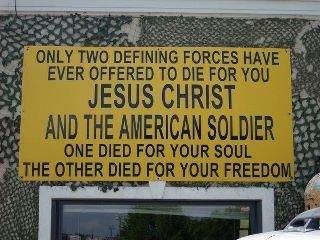
More Nationalistic Interpretations
Subscribe to:
Posts (Atom)